
The Uninvited Algorithm at America’s Dinner Table
Part One (of Three) : How Palantir Seized Control of America's Farm Infrastructure

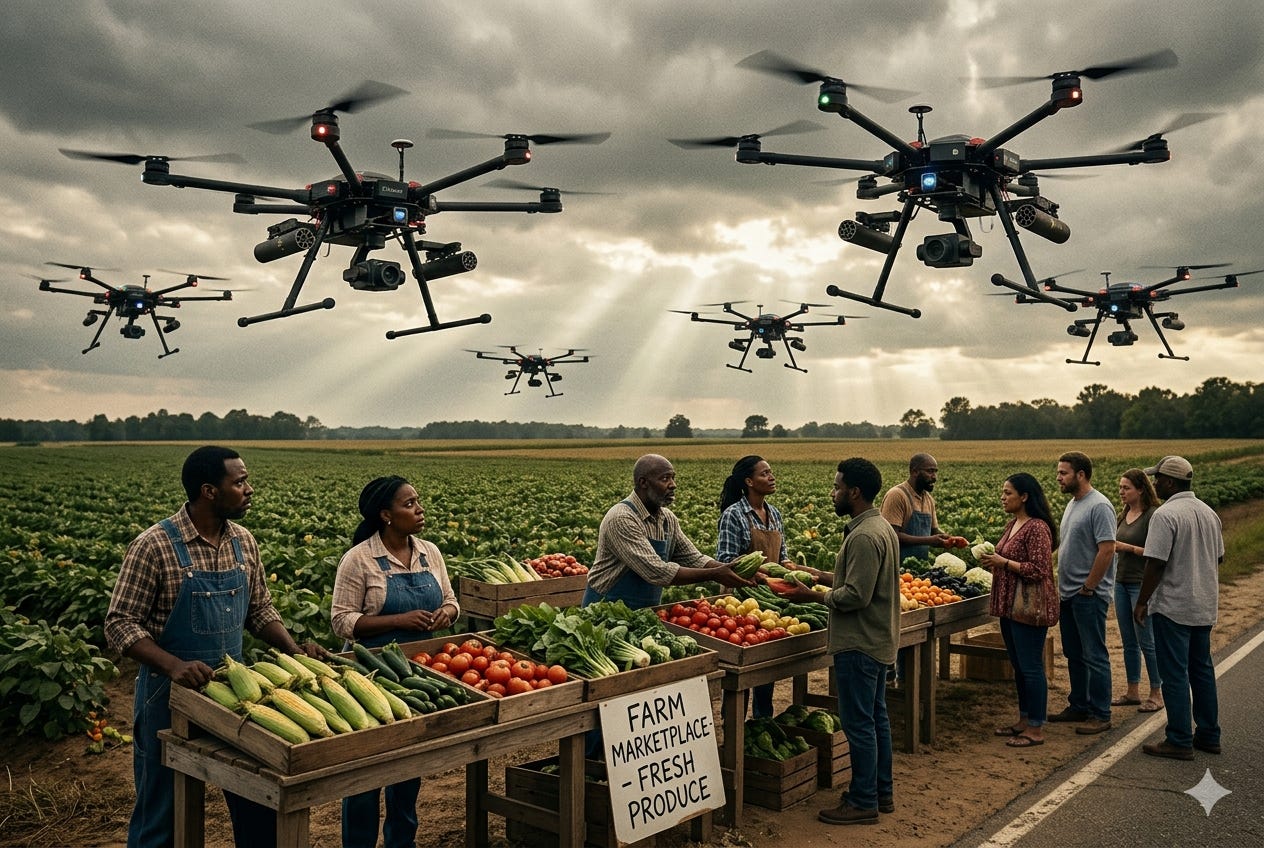
Yusuf Jones | The Dajalé Institute
April 2026
INCIDENT TRACE: THE FARMER FILES
The press release arrives at 7:00 in the morning.
By the time most American farmers have already finished their first hour of work — before the sun has fully cleared the tree line in Iowa, before the irrigation systems have cycled in the Central Valley, before the first delivery trucks have pulled out of the cold storage facilities in the Mississippi Delta — the deal is already done. Three hundred million dollars. A Blanket Purchase Agreement. The United States Department of Agriculture and Palantir Technologies, signed and announced and celebrated before the country has had its coffee.
The document calls it “One Farmer, One File.”
Somewhere in a county office in rural Tennessee, a third-generation tobacco farmer has a folder. It is worn at the edges. It holds his acreage reports, his subsidy applications, his crop insurance filings, the handwritten notes from a conversation with an extension agent fifteen years ago. It holds the record of what he planted and when and how much he received and what he still owes. It is his agricultural life in paper form, imperfect and fragmented and entirely his.
That folder is now the problem Palantir has been paid three hundred million dollars to solve.
The Landmark platform — already embedded inside USDA systems, already having processed $4.4 billion in farmer payments in the first five days of its deployment, already having broken, in Palantir’s own words, every prior USDA record for online farmer sign-ups within sixty-two minutes of opening — is now the foundation.
Not a pilot.
Not an experiment.
A foundation.
What gets built on foundations does not get removed easily.
One farmer. One file. Every acreage report. Every payment. Every subsidy application. Every flag for fraud. Every marker of foreign adversary influence, however that term comes to be defined by whoever holds the administrative keys. Consolidated. Unified. Secured.
By a company whose other secured files include targets for drone strikes.
The farmer in Tennessee does not know that Palantir built the targeting systems that selected coordinates in Mosul.
He does not know that the same data architecture that learned to distinguish a combatant from a civilian in an Afghan village has now been contracted to distinguish a legitimate farmer from a fraudulent one in his county. He does not know that “fraud, abuse, and foreign adversary influence” are not legal definitions with established evidentiary standards — they are algorithmic categories, populated by pattern recognition, trained on data he did not consent to provide and cannot audit or appeal.
He knows that the new system is faster.
He knows that he enrolled in sixty-two minutes without driving to the county office.
He knows that the check came in five days instead of five weeks.
He knows that the government called this a success.
He does not know that speed is how capture gets consented to.
The National Farm Security Action Plan does not explain what triggers a fraud flag. It does not specify what data points constitute evidence of foreign adversary influence. It does not describe the appeals process when the algorithm marks a file and the payment stops. It does not name the human being who reviews the flag, or whether a human being reviews it at all. It offers visibility and speed — the USDA Chief Information Officer’s own words — and it offers them as if visibility and speed are neutral goods, as if the question of who has visibility, and into what, and toward what end, is a question that responsible administrators do not need to answer in public.
Precision is the word that does the work.
Precision is what a system achieves when it has enough data to sort with confidence. Precision is what Palantir sold to ICE when it built the targeting architecture for deportation operations. Precision is what it sold to the intelligence community when it built the pattern recognition systems that map human networks for elimination. Precision, in Palantir’s operational history, has never been a neutral instrument. It has always pointed somewhere. It has always landed on someone.
The Blanket Purchase Agreement is not a contract with an end date. It is a standing vehicle, a pre-approved channel through which the federal government can continue to direct funds to Palantir without returning to competitive bidding, without re-justifying the relationship, without submitting the arrangement to public scrutiny each time the scope expands. The three hundred million dollars announced this morning is not a ceiling. It is an opening. What gets purchased through a blanket agreement is purchased at the discretion of the agency, on a timeline the agency sets, for purposes the agency defines, with a vendor already embedded in the infrastructure, already holding the data, already the only entity that fully understands the system it built.
Palantir did not arrive at the USDA this morning. It arrived earlier, quietly, with the Landmark platform.
It arrived as a solution to a problem that the agency had been told, for years, it was not equipped to solve alone. The Pilot-to-Platform Pipeline™ does not announce itself. It holds a press conference when the platform is already load-bearing — when the data is already consolidated, when the staff has already been trained on the interface, when the legacy systems have already been decommissioned or allowed to atrophy, when the question of whether to continue is no longer a policy question but an operational one. When leaving would mean the payments stop. When leaving would mean the files fragment. When leaving would mean that sixty-two minutes becomes six weeks again, and the farmer in Tennessee is back in the county office, and the Secretary has to explain to Congress why the modernization failed.
Palantir understood this before the first contract was signed.
The announcement this morning calls it a continuation. That word is doing more work than the press release acknowledges. Continuation means the decision was made earlier, in a quieter room, before the three hundred million dollars made it into a headline. Continuation means that what is being announced today is not a beginning. It is a ratification.
The file already exists. The platform is already load-bearing. The relationship is already structural.
The morning’s press release is the receipt.
SECTION I: THE CAPTURE EVENT
The United States Department of Agriculture is not a national security agency.
Its statutory mandate is the support of American agricultural producers, the administration of food assistance programs, the management of natural resources, and the promotion of agricultural trade. It was not designed to operate surveillance infrastructure. It was not designed to administer algorithmic fraud detection systems whose categories are defined by a private vendor. It was not designed to serve as a node in the national security apparatus that governs the identification and neutralization of foreign adversary influence in domestic civilian life. It was designed to help farmers farm and to ensure that the food supply those farmers produce moves efficiently from the land to the population that depends on it.
What it has become is something the statutory mandate does not describe and the press release does not acknowledge.
The $300 million Blanket Purchase Agreement signed between the USDA and Palantir Technologies on April 22, 2026 is not a technology modernization contract in any meaningful sense of that phrase. It is a capture event — the moment at which a civilian government agency whose primary obligation is service delivery to a specific population formally cedes the data infrastructure through which it executes that obligation to a private surveillance company whose primary expertise is the construction of targeting and sorting systems for military and intelligence operations, and whose operational history demonstrates, without ambiguity, that the populations whose data it holds are never the populations whose interests it serves.
Palantir Technologies was seeded by the Central Intelligence Agency’s venture capital arm, In-Q-Tel, in 2004. It built its foundational architecture in support of intelligence community targeting operations — the pattern recognition systems that map human networks for surveillance, interdiction, and elimination in contexts the public is not fully informed about and cannot fully account for.
It extended that architecture into domestic law enforcement through contracts with the New York Police Department, whose Demographics Unit used Palantir infrastructure to map Muslim community networks without predicate suspicion, without judicial oversight, and without the knowledge of the communities being mapped.
It extended it further through Immigration and Customs Enforcement’s Investigative Case Management system — the targeting architecture that generates deportation coordinates, that identifies, tracks, and processes human beings for removal before a legal review has determined that removal is warranted.
It has extended it into predictive policing platforms deployed in cities from New Orleans to Los Angeles, sorting racialized populations by algorithmic risk scores generated by criteria no affected community has been permitted to examine.
This is the company that now holds the unified file on every American farmer.
The Pilot-to-Platform Pipeline™ identifies the mechanism through which this capture was accomplished, because Palantir did not arrive at the USDA on April 22, 2026. It arrived earlier, quietly, with the Landmark platform, embedded first as a solution to a genuine operational crisis. The legacy systems that administered USDA payment programs could not process the volume and velocity that the Farmer Bridge Assistance Program required. Eleven billion dollars needed to move. Palantir could move it. Within sixty-two minutes of the program opening, it broke every prior USDA record for online farmer enrollment. Within five days, it had disbursed $4.4 billion directly to farmers without requiring a single county office visit. The performance was unambiguous. The metrics were unimpeachable. And performance, in the logic of the Pilot-to-Platform Pipeline™, is not the end of the arrangement. It is the beginning of the justification for everything that follows.
The Pipeline operates in three phases whose progression is neither accidental nor improvised.
The first phase is crisis insertion. A genuine operational failure — legacy systems incapable of executing a mandated program at the required scale — creates the entry point. The vendor does not manufacture the crisis. It positions itself as the only available solution at the moment the crisis demands one, ensuring that the first data point in the relationship between the agency and the vendor is an experience of irreplaceability. Palantir moved eleven billion dollars when the USDA could not. That fact becomes the foundation on which every subsequent expansion of the relationship is constructed, because no administrator who presided over sixty-two minutes and five days will authorize the dismantling of the system that produced them.
The second phase is performance legitimation. The pilot succeeds. The metrics proliferate. The success story enters the press release, the congressional testimony, the interagency communication. And the success story does something more consequential than demonstrate value — it converts scrutiny into ingratitude. To ask what Palantir does with the data after the payment clears is, in the administrative environment that performance legitimation produces, to question a system that is working. To ask what a fraud flag looks like from inside the file it marks is to introduce friction into an efficiency that the agency has staked its reputation on. Performance legitimation does not silence criticism through argument. It silences it by making criticism seem beside the point — the point being that the payments moved and the farmers enrolled and the records were broken and the system works.
The third phase is structural absorption. The Blanket Purchase Agreement is the legal instrument of this phase, and its architecture requires examination that the press release does not invite. A blanket purchase agreement is not a contract with a defined scope and an end date. It is a standing procurement vehicle — a pre-approved channel through which the agency can continue to direct funds to the vendor without returning to competitive bidding, without re-justifying the relationship, without submitting the arrangement to public scrutiny each time the scope expands or the purpose evolves. The $300 million announced on April 22, 2026 is not a ceiling. It is an opening authorization. What gets purchased through a blanket agreement is purchased at the agency’s discretion, on a timeline the agency sets, for purposes the agency defines — with a vendor already embedded in the infrastructure, already holding the data, already the only entity th
at fully understands the system it built.
This is the administrative definition of dependency.
And dependency, in the logic of the Pilot-to-Platform Pipeline™, is not a side effect of the arrangement. It is the product. Every legacy system that is decommissioned or allowed to atrophy in the transition to Palantir’s platform is a reduction in the USDA’s capacity to function without Palantir. Every farmer enrolled through the Landmark interface is a data point that exists, in its unified and consolidated form, only inside architecture the government does not own and cannot replicate. Every payment processed through the platform is a transaction that has passed through infrastructure whose inner workings are proprietary to a company whose obligations run to the Department of Agriculture and its shareholders — not to the farmers whose data it holds, not to the communities whose food security depends on the decisions the platform will make, and not to the democratic institutions whose statutory authority the arrangement has quietly displaced.
The USDA announced this as modernization.
The Dajalé Institute identifies it as algorithmic capture.
And what the history of every colonial food governance system from Bengal to the Bantustans to the plantation economy of the American South teaches, with a consistency that no administrative euphemism has ever successfully obscured, is that capture of the infrastructure through which a population accesses food is never only about the infrastructure. It is about the population. It is about which populations the captured infrastructure will serve, which it will sort, which it will flag, and which it will dispossess — questions that the press release does not answer because the press release was not written for the populations who will bear the answers in their bodies.
Those populations require a different accounting.
THE OLDEST WEAPON
There is no more ancient instrument of colonial governance than the control of food.
Before the algorithm, before the database, before the blanket purchase agreement and the unified digital file and the real-time supply chain monitoring platform, there was the granary. There was the ration card. There was the deliberate engineering of hunger as administrative policy — not the accidental consequence of mismanagement, but the calculated deployment of starvation as a technology of population control, of territorial consolidation, of the destruction of communities whose continued existence represented a challenge to the order being imposed upon them.
The British administration of Bengal understood this in 1943, when supply management decisions it controlled contributed to the deaths of between two and three million people while grain continued to be exported from the subcontinent.
The apartheid government of South Africa understood this when it used Bantustan agricultural policy to ensure that Black South African communities remained structurally dependent on white-controlled food systems, unable to achieve the economic sovereignty that land and food production would have provided.
The colonial administrators of the Belgian Congo understood this when they converted subsistence agricultural land into forced-labor rubber and cotton production, engineering food scarcity as the mechanism that made refusal of colonial labor demands a death sentence rather than a choice.
But no colonial governance system deployed food as a weapon of population control with more sophistication, more duration, or more lasting structural consequence than the plantation economy of the American South.
The plantation was not simply an agricultural operation. It was a total governance system — a closed administrative environment in which the control of food was the foundational instrument of discipline, compliance, and the reproduction of captive labor across generations.
Enslaved people did not control what they grew, though their labor produced it. They did not control what they ate, though their bodies sustained the entire productive apparatus of the system. Food was distributed by the enslaver as ration — calibrated to maintain productive capacity without enabling the physical strength or the economic independence that resistance required. The smokehouse was locked. The garden plot was permitted or denied as a function of compliance.
The calorie was the first and most reliable instrument of submission, administered not through market mechanisms but through the direct administrative authority of a governance system that had converted human beings into productive units whose biological needs were inputs to be managed rather than lives to be sustained.
This was not incidental to the plantation economy. It was it's purpose.
And it did not end with emancipation. The sharecropping system that replaced chattel slavery reproduced the food governance logic of the plantation through contractual rather than property mechanisms — the crop lien, the company store, the debt that reset every harvest season, the perpetual dependency on a white landowner’s administrative decisions about what the Black farming family would have access to and when.
The Great Migration was not only an escape from racial terror. It was an escape from a food governance system designed to ensure that Black agricultural labor remained bound to land it would never own, producing food it would never fully control, in a regional economy structured to prevent the accumulation of the agricultural wealth that food production, under any other administrative arrangement, would have generated.
The United States Department of Agriculture was the federal instrument through which that regional food governance logic was nationalized, formalized, and administered across the twentieth century, not as a departure from its statutory mandate, but as its operational expression.
The county committees that denied loans to Black farmers while approving identical applications from white ones were not rogue actors violating agency policy. They were the agency policy, executing through local administrative structures the same sorting logic the plantation had executed through property law and physical coercion.
What changes in the algorithmic era is not the logic.
What changes is the instrument through which that logic is executed, the scale at which it operates, and the invisibility that technical administration provides to governance decisions that, made by human administrators in county offices, were at least legible enough to be contested, documented, and litigated over the course of a century of organized resistance.
The algorithmic governance of food infrastructure requires none of the visibility that human administration, however corrupt, inevitably produces. It requires a platform, a unified file, a pattern recognition system whose thresholds are proprietary, whose categories are elastic, whose flags are generated before a human reviewer enters the room — and a government willing to hand that platform to a private surveillance infrastructure company under a standing procurement agreement that persists beyond the political moments that might otherwise force reconsideration.
The plantation kept its ledger in a book that could be found, photographed, entered into evidence, and carried into a courtroom by lawyers who spent careers constructing the arguments that produced, however inadequately, some measure of administrative accountability.
The Palantir file has no such vulnerability — and what that means for the populations whose agricultural lives it now contains is precisely what the racial architecture of the arrangement, examined in full, reveals.
What the $300 million Blanket Purchase Agreement purchases, beyond the platform and the unified file and the fraud detection infrastructure and the foreign adversary influence categories, is a specific kind of administrative amnesia — the conversion of a relationship between a government and its people into a relationship between a government and its vendor, in which the vendor's continued presence becomes the condition of the government's continued function, and the question of what the vendor is doing with the data it holds becomes, by the logic of dependency the Pipeline produces, a question that responsible administrators no longer feel authorized to ask in public.
The farmer in Tennessee consented to sixty-two minutes and five days. He did not consent to what the platform will do with his file when the next crisis arrives and the categories expand and the flag appears and the payment stops. That accounting — of who bears the consequences of the precision, and why, and along what lines of history the sorting has always run — requires a longer memory than the press release carries and a deeper archive than the Landmark platform was built to hold.
Upcoming in Part II :
The Uninvited Algorithm at America's Dinner Table
Part Two (of three): The Oldest Weapon: Food, Race, and the Architecture of Agricultural Dispossession