
The Algorithm Hates Your Face: How Trump’s Deportation Machine Targets Black Bodies
ICE’s deportation machine targets Blackness itself—citizenship is no protection from systems built to control all Black people.

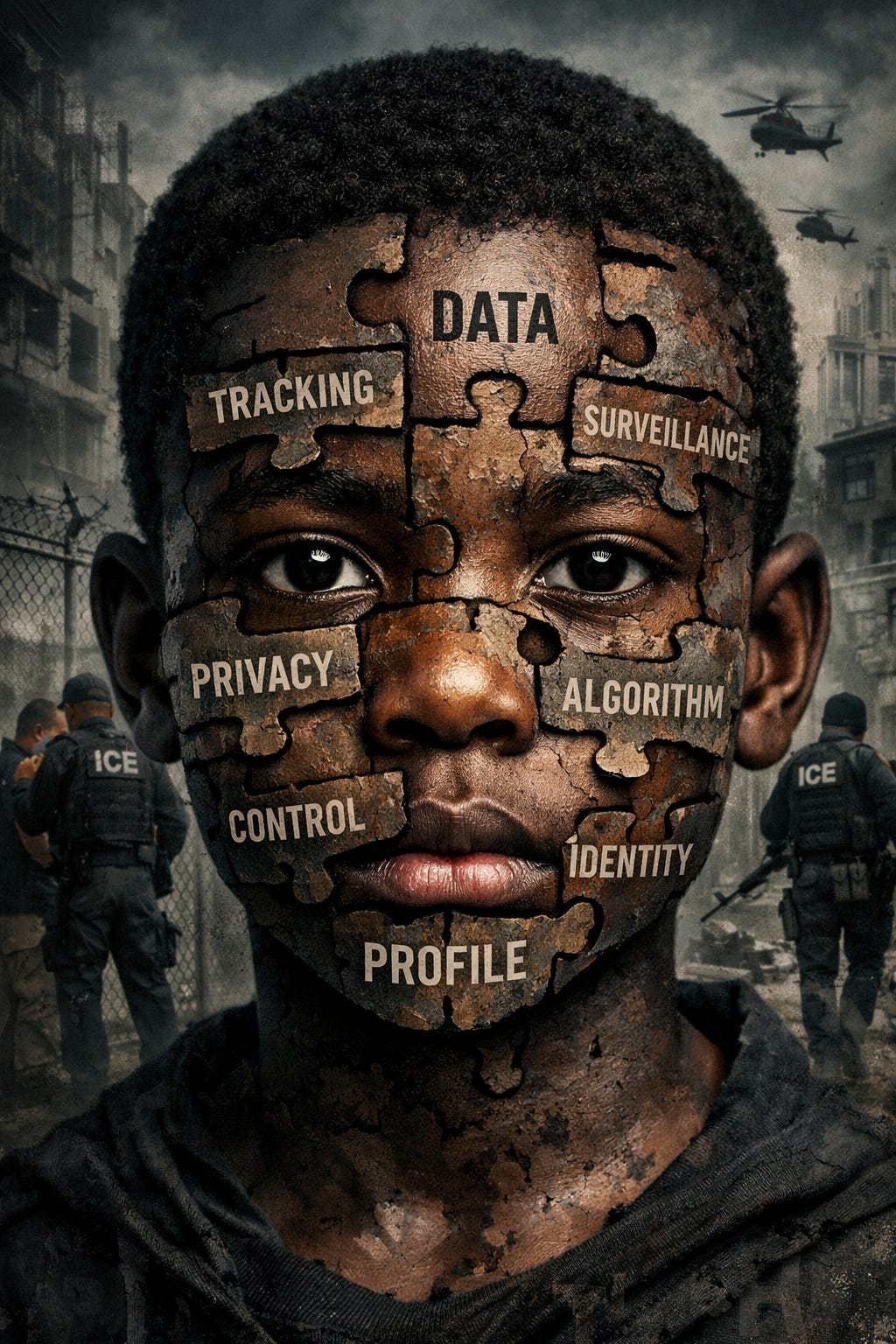
Jean Jimenez-Joseph was twenty-seven years old when he died at the El Paso Processing Center in May 2017. For six days, he had reported severe abdominal pain to guards at the ICE detention facility. For six days, guards refused to call medical staff, convinced he was “faking to get out of work detail.” By the time he collapsed, his appendix had ruptured—a condition that would have been survivable with timely treatment. The autopsy made clear: Jean died because the people paid to guard him assumed a Black Panamanian man in pain was lying. His death was not tragedy. It was the predictable outcome of systems designed to devalue Black life—systems that don’t distinguish between Black migrants, Black naturalized citizens, and Black people born in America. The algorithm that flags Jean as “higher risk” because of his Blackness operates identically whether processing a Haitian asylum seeker, a Jamaican lawful permanent resident, or a Black American citizen stopped at a traffic checkpoint and fingerprinted by police whose databases feed directly into ICE surveillance networks.
Black migrants represent only 6% of people detained by Immigration and Customs Enforcement, yet they account for 22% of deaths in ICE custody. But immigration detention’s anti-Black violence cannot be separated from the broader apparatus targeting all Black people in America. The same private corporations—GEO Group and CoreCivic—operate both ICE detention facilities and county jails incarcerating Black citizens at rates six times higher than white citizens.
The same algorithmic risk assessment tools that recommend detention for Black migrants were first developed and tested on Black defendants in criminal courts, Black families in child welfare systems, and Black applicants for public housing.
The same biometric databases collecting fingerprints from Black migrants apprehended at borders simultaneously store prints from Black Americans arrested during routine police stops, creating unified surveillance infrastructure that tracks all Black bodies regardless of citizenship status. The same Southern facilities holding Black migrants on former plantation grounds previously held—and in many cases still hold—Black American prisoners subjected to identical conditions of medical neglect, solitary confinement, and forced labor at wages unchanged since convict leasing.
To understand how we arrived at a place where algorithms determine who lives and dies in American detention facilities, where corporations profit from Black suffering at industrial scale, and where the infrastructure of slavery has been digitized rather than dismantled, we need frameworks capable of naming what conventional language obscures. Immigration enforcement under Trump wasn’t a border security crisis—it was the crystallization and expansion of a high-tech apartheid system targeting all Black people in America, using migration as entry point while building surveillance and control infrastructure that operates without regard to citizenship. Black migrants face ICE’s brutality, but Black American citizens face the same corporations, the same algorithms, the same carceral geographies, and the same state-corporate fusion that treats Blackness itself as threat requiring technological management and profitable confinement.
Black Lives, White Control
The numbers refuse the fiction that immigration enforcement operates neutrally. Black migrants detained by ICE face abuse, violence, and death at rates that would constitute national scandal if the disparities were acknowledged rather than buried in agency statistics that rarely disaggregate by race. Black detainees comprise 6% of the ICE detention population but account for 28% of abuse reports filed through official channels—a rate 4.7 times higher than their population share would predict (Freedom for Immigrants, 2022). These abuses are not isolated incidents but systematic patterns: physical violence by guards who strike, choke, and sexually assault Black detainees at triple the rates they assault others; solitary confinement placements where Black migrants represent 41% of those held in isolation despite being 6% of the population; and deaths from medical neglect where Black detainees receive dismissive rather than diagnostic responses to health complaints. Freedom for Immigrants’ comprehensive 2022 investigation documented that guards at ICE facilities call Black migrants “monkeys” and “boy,” place them in solitary confinement for an average of 47 days compared to 23 days for non-Black detainees, and routinely dismiss their medical complaints as malingering or manipulation—the same assumption that killed Jean Jimenez-Joseph.
The geographic concentration of these facilities exposes the infrastructure’s genealogy. Sixty-four percent of ICE detention centers are located in states of the former Confederacy, many occupying sites with direct lineages to slavery, convict leasing, and Jim Crow incarceration (Detention Watch Network, 2020). River Correctional Center in Louisiana, operated by GEO Group for ICE, sits on the grounds of the former Louisiana State Penitentiary at Angola—itself built on Angola plantation where enslaved people once harvested cotton. Pine Prairie ICE Processing Center was constructed on land adjacent to Pine Prairie plantation, employing architectural designs that replicate antebellum labor camp layouts with dormitories radiating from central guard towers. LaSalle Detention Facility in Jena, Louisiana occupies land where convict-leased Black prisoners were forced to harvest timber in the early twentieth century. These facilities didn’t accidentally end up in the South. They’re there because the infrastructure for controlling Black bodies—physical buildings, institutional cultures, regional political economies dependent on incarceration—never disappeared. It was preserved, adapted, and upgraded with digital surveillance systems, biometric databases, and algorithmic risk assessments that automate what overseers and guards once did manually.
The automation becomes explicit when examining ICE’s Risk Classification Assessment algorithm, which scores detainees on “flight risk” and “danger to community” to determine whether they should be detained, released on bond, or enrolled in electronic monitoring programs. Research by UCLA Law School professor Ingrid Eagly documented that the RCA algorithm recommends detention for Black migrants at rates 37% higher than for Latinx migrants with identical criminal histories, visa statuses, and community ties (Eagly, 2017). The disparity stems from variables that function as racial proxies: prior arrests capture over-policing in Black neighborhoods rather than actual criminality; employment instability reflects labor market discrimination rather than individual irresponsibility; lack of community ties measured through home ownership encodes housing discrimination’s outcomes. The algorithm treats structural racism’s effects as individual risk characteristics, mechanizing anti-Black bias through mathematical operations that appear objective because they’re computational.
The Incarceration-Industrial Complex Has a New Market
Immigration detention’s brutality toward Black migrants generates guaranteed revenue for the private prison corporations that operate 90% of ICE’s detention infrastructure (Brennan Center for Justice, 2025). GEO Group and CoreCivic—the two largest private prison companies in the United States—transformed Trump’s deportation agenda into profit projections that executives announced to shareholders with celebratory language usually reserved for product launches or market expansions. GEO Group CEO George Zoley told investors in November 2024, immediately following Trump’s electoral victory, that the company anticipated “an extra $400 million in annual revenue from mass deportations” under the incoming administration (Brennan Center for Justice, 2025). CoreCivic CEO Damon Hininger described his company as “perfectly aligned” with Trump’s enforcement priorities and projected 15-20% revenue growth if the administration implemented its stated deportation goals (Cunningham-Cook, 2025). These were not speculative hopes but confident forecasts grounded in the financial architecture of immigration detention: contracts structured to guarantee profits regardless of conditions, oversight, or outcomes.
The contract mechanisms reveal how detention commodifies human beings. ICE pays private contractors through “guaranteed minimum” agreements that compensate firms for bed capacity rather than actual occupancy—meaning GEO Group and CoreCivic receive full payment whether detention beds are filled or empty. Between 2015 and 2019, ICE paid private contractors $1.2 billion for approximately 10,000 empty beds, ensuring corporate profitability even during periods when detention populations declined (Schwellenbach & Kladzyk, 2019). The per-diem rates range from $120 to $160 per detainee per day depending on facility security classification, with contracts structured so that companies keep any difference between the fixed rate and actual costs. This incentivizes minimizing expenditures on food, medical care, and staffing while maximizing occupancy. Office of Inspector General investigations consistently found that private detention facilities spend less on meals, mental health services, and recreation than government-operated facilities despite receiving identical per-diem payments—the savings flow directly to corporate profits (Office of Inspector General, 2018).
The profit extraction extends beyond detention beds to detained labor. ICE facilities operate “Voluntary Work Programs” that pay detainees one dollar per day for work maintaining facilities, preparing meals, and performing janitorial services—a rate established in 1950 and never increased (Depot & Tewarie, 2021). Internal GEO Group emails obtained through litigation revealed executives acknowledging that paying even minimum wage for this work “would require per-diem rates increasing from $98 to $145+, potentially making contracts unprofitable” (Nwauzor v. GEO Group, 2017). The company depends on wage theft—calling it “voluntary” despite detainees facing solitary confinement or loss of privileges if they refuse assignments—as essential component of its business model. This is convict leasing with a corporate logo: private firms receiving government payments per captive body while extracting maximum labor for minimal compensation. The Ninth Circuit Court of Appeals ruled in 2021 that ICE detainees are not protected by federal labor laws because detention is classified as civil rather than criminal confinement, effectively exempting immigration detention from any labor standards whatsoever (Nwauzor v. GEO Group, 2021).
The corporations secured this profitable arrangement through systematic corruption that collapsed any meaningful distinction between ICE as regulatory authority and GEO/CoreCivic as regulated entities. Thomas Homan served as acting director of ICE from January 2017 to June 2018, overseeing all detention policy and contract negotiations during Trump’s first eighteen months in office. Prison Legal News investigations revealed that Homan was simultaneously receiving consulting payments from GEO Care, a GEO Group subsidiary providing healthcare services in detention facilities, with final payments processed days before his federal swearing-in (Prison Legal News, 2025). Upon leaving ICE, Homan continued relationships with GEO while maintaining policy influence as Fox News contributor and Trump campaign advisor, eventually returning as informal “border czar” in Trump’s second term. Daniel Bible’s trajectory proved even more direct: as ICE’s deputy executive associate director for enforcement and removal operations, he oversaw all detention operations and personally approved a $110 million contract modification expanding GEO’s Adelanto detention center capacity. Three months later, he was hired as Executive Vice President of GEO Group’s U.S. Corrections and Detention division, with compensation packages including performance bonuses tied to federal contract acquisition (Schwellenbach & Kladzyk, 2019). At least twenty-eight senior ICE and Customs and Border Protection officials joined private detention, surveillance, or border security firms during Trump’s first term, creating networks through which corporate priorities shaped federal policy while insider knowledge enabled strategic contract positioning (CREW, 2020).
The financial relationships extended directly into Trump’s political operation. GEO Group and CoreCivic collectively donated $2.78 million to Trump’s 2024 campaign cycle and inaugural committee, with GEO contributing $875,000 to the inauguration alone (Culliton-Gonzalez & Elsharif, 2024). These contributions purchased access: GEO’s CEO George Zoley served on Trump’s transition team as advisor on immigration enforcement and prison policy, participating in closed-door meetings that developed the executive orders Trump signed on his first day in office mandating detention expansion. The timing reveals the transactional nature: contributions preceded the $45 billion ICE appropriation in fiscal year 2025, the largest immigration enforcement budget in U.S. history. Black migrants aren’t just detained—they’re commodified. Each body in a cell generates guaranteed revenue. Each person on an ankle monitor generates monthly fees. Each hour of labor at one dollar per day generates profit margins that would make nineteenth-century plantation owners envious. The system doesn’t need to be humane. It just needs to be full.

The Algorithm Already Decided You’re Dangerous
The real innovation of Trump-era enforcement wasn’t profit extraction—that’s as old as convict leasing. The innovation was automating discrimination at scale through computational systems that flag, track, and target populations while diffusing accountability behind claims of algorithmic objectivity. ICE’s expanding reliance on data analytics platforms, biometric surveillance networks, and electronic monitoring technologies represents the technocratic dimension of contemporary apartheid: racialized control implemented through algorithms that learn from history where Black people were always already marked as threats, then mechanize that history to process millions.
Accurint, a data analytics platform provided by LexisNexis Risk Solutions, became ICE’s primary tool for identifying deportation targets under Trump. The agency’s contract with LexisNexis grew from $4.2 million annually under Obama to $26.1 million annually by 2019, purchasing unlimited access to a platform that aggregates data from over 10,000 sources including credit reports, utility records, employment databases, social media platforms, vehicle registrations, property records, and court filings (U.S. Immigration and Customs Enforcement, 2020). Accurint employs machine learning algorithms to generate “deportability scores” predicting which individuals are likely to be undocumented based on patterns the system identifies across these data sources. Georgetown Law Center on Privacy & Technology’s investigation documented that the algorithm flags people for ICE investigation based on factors including Spanish-language social media use, residence in historically Latinx neighborhoods, employment in industries with high undocumented workforces like agriculture or construction, and patterns of financial transactions suggesting lack of credit history (Georgetown Law Center on Privacy & Technology, 2021).
Each variable captures structural inequality rather than immigration status: Spanish-speakers face employment discrimination encouraging occupational concentration; Latinx neighborhoods result from housing segregation; agricultural work reflects employer exploitation of vulnerable workers; credit history gaps reflect banking discrimination and immigrant financial exclusion. But Accurint treats these outcomes of systemic discrimination as individual characteristics indicating unauthorized presence, producing ranked lists where people scored 95 are deemed “very likely undocumented” and prioritized for enforcement.
The platform’s racial dimensions intensify when analyzing how it processes Black migrants. The algorithms were trained primarily on historical ICE enforcement data from operations targeting Latinx communities, meaning the system “learned” to identify deportability through proxies strongly correlated with Latinx ethnicity. When applied to Black migrants from Africa or the Caribbean, the algorithms often fail to flag them initially—not because they extend protection but because they weren’t designed with Black migration patterns in mind. Yet paradoxically, when Accurint does identify Black migrants, they face classification as “higher risk” because historical data shows they were more likely to have prior police contact. This reflects over-policing in Black neighborhoods rather than actual propensity for immigration violations, but the algorithm treats arrests as risk indicators. Research by Ruha Benjamin documents this creates a double bind: Black migrants are simultaneously under-surveilled by algorithms optimized for Latinx enforcement patterns and over-criminalized when algorithms do identify them, resulting in enforcement characterized by both algorithmic neglect and algorithmic brutality (Benjamin, 2019).
The biometric infrastructure parallels and extends algorithmic targeting. Trump administration officials dramatically expanded the Biometric Identification Transnational Migration Alert Program (BITMAP), which collects fingerprints and facial scans from migrants apprehended in partner countries and transmits that data to U.S.-controlled databases. Under Trump, BITMAP grew from eight participating countries collecting approximately 150,000 biometric records annually to twenty-four countries collecting over 1.2 million records annually by 2020 (U.S. Department of Homeland Security, 2020). The program operates through “capacity building” grants where DHS funds biometric collection infrastructure in Mexico, Guatemala, Honduras, and increasingly throughout Central America, South America, and Africa. The data flows unidirectionally: partner countries submit biometrics to DHS servers in the United States where they’re integrated with FBI criminal databases, ICE deportation records, and CBP entry-exit systems, but partner countries receive only limited query access to their own collected data. When someone is biometrically enrolled after apprehension in Chiapas, Mexico, that enrollment creates a permanent record accessible to U.S. law enforcement indefinitely. If they later obtain a visa and attempt legal entry, the biometric match flags them as having attempted illegal crossing, often resulting in visa denial. If they successfully enter and ICE later seeks to deport them, the BITMAP record provides evidence of prior removability.
Facial recognition technology deployed in this infrastructure exhibits documented bias against Black faces. Multiple peer-reviewed studies demonstrate that facial recognition algorithms exhibit error rates for Black faces ten to one hundred times higher than for white faces, with errors skewing toward false positives—the systems incorrectly identify Black people as matches to watchlists or databases far more frequently than they misidentify white people (Buolamwini & Gebru, 2018). When ICE uses facial recognition to identify deportation targets, these biases generate wrongful detentions of Black migrants at systematically higher rates. Georgetown Law’s 2019 investigation documented forty-two cases where Black migrants were detained by ICE based on faulty facial recognition matches, held for weeks or months, then released when manual verification revealed the algorithmic error (Georgetown Law Center on Privacy & Technology, 2019). In one documented case, a Jamaican lawful permanent resident was detained for eighty-seven days after facial recognition software incorrectly matched him to a deportation order issued for a different person with a similar name. He presented documentary evidence of his legal status immediately, but ICE agents deferred to the algorithmic match, treating computational output as more authoritative than legal documents.
Electronic monitoring extends algorithmic control beyond detention facilities while generating comparable profits for contractors. BI Incorporated, a wholly owned GEO Group subsidiary, operates ICE’s Intensive Supervision Appearance Program (ISAP), which has grown from monitoring 30,000 people in 2014 to 186,000 in 2025 (Guerrero, 2025). The program employs GPS ankle monitors, smartphone applications requiring facial recognition check-ins, and telephonic reporting systems that track participants continuously. GEO executives project that restoring monitoring to the program’s 2019 peak of 370,000 participants would generate approximately $250 million in additional annual revenue, with CEO Zoley explicitly connecting expansion to Trump’s return to office (Brennan Center for Justice, 2025). Freedom for Immigrants’ documentation of ISAP participants’ experiences reveals that Black migrants face stricter monitoring conditions, higher rates of technical violations for identical behaviors, and injuries from malfunctioning ankle monitors at rates significantly exceeding other monitored populations (Freedom for Immigrants, 2022).
The algorithm doesn’t need to explicitly say “Black people are dangerous.” It just needs to learn from a history where Black people were always already marked as threats requiring heightened surveillance and control.
Then it automates that history at planetary scale, processing millions of decisions annually while generating profits for corporations and creating accountability gaps where no individual can be held responsible for systematic discrimination that’s technically legal because it’s algorithmic.
Why These Powerful Frameworks Matter
Conventional analytical frameworks consistently fail to capture what’s documented here because they treat immigration detention’s brutalities as implementation failures rather than design features, missing how algorithmic systems, corporate profit extraction, anti-Black violence, and transnational control operate as integrated apparatus. Human rights frameworks identify abuses and propose oversight mechanisms, yet decades of documentation haven’t reduced detention populations because oversight doesn’t challenge detention’s purposes—disciplining labor, extracting profit, projecting imperial power, maintaining racial hierarchies. Mass incarceration frameworks reveal carceral continuities linking immigration detention to domestic prisons but struggle to explain the transnational dimensions: why the same technologies operate identically in Guatemalan detention centers, why biometric data extracted in Honduras feeds deportations from Louisiana, why corporations export the “U.S. model” to Australia. Neoliberal governance frameworks expose privatization but miss algorithmic automation’s specific function in diffusing accountability—how discrimination becomes deniable as “what the algorithm recommended” even when algorithms were designed to discriminate. Border militarization frameworks document enforcement escalation but can’t explain why detention expanded under Trump even as some jurisdictions reduced criminal incarceration, or why identical surveillance systems target both border-crossers and Black citizens in cities eight hundred miles from any border.
Technocratic Neo-Apartheid™ and Technocratic Neo-Colonialism™ succeed where these frameworks falter by insisting on what others bracket or ignore: that algorithmic systems don’t accidentally discriminate but systematically produce racialized stratification because producing it is their function, obscured through technical mediation that allows plausible deniability. The frameworks name how detention operates simultaneously as domestic segregation and global extraction, how corporate profit isn’t incidental corruption but constitutive infrastructure, how anti-Black violence structures enforcement even in ostensibly nationality-based systems, and how technological automation doesn’t reduce discrimination but mechanizes it at scales impossible through human decision-making alone. TNA™ captures the domestic production of racialized hierarchy through ostensibly neutral computational systems—algorithmic checkpoints requiring continuous identity verification, risk assessments flagging Blackness as threat indicator, electronic monitoring extending carceral control beyond facility walls, spatial segregation concentrating detention in regions with established anti-Black infrastructure. TNC™ captures the global extension of these systems to manage transnational labor flows and maintain exploitative North-South relationships—biometric colonization extracting data from Global South populations for storage in U.S.-controlled databases, deportation functioning as economic weapon destabilizing sending countries, border externalization agreements coerced through aid threats, enforcement technologies exported as commodities that other countries purchase to implement similar control.
The frameworks’ power lies in their refusal of euphemism and their insistence on abolitionist implications. If these systems function as designed to produce apartheid-like segregation domestically and colonial-style extraction globally, reform cannot address them—only dismantling can. The evidence demands recognizing immigration detention not as broken system requiring better implementation but as successful system serving its intended purposes: extracting profit from Black and brown suffering, disciplining migrant labor into accepting exploitation, maintaining racialized hierarchies through computational means, and projecting U.S. imperial power through technological infrastructure. What algorithms built, organizing can dismantle—but only if we name clearly what must be dismantled and refuse the reformist language that treats adjustment as adequate response to structural violence.
The Work Ahead
Trump’s deportation machine made explicit what was always implicit: immigration enforcement is racialized violence automated for corporate profit, targeting Black and brown bodies through systems that claim neutrality while producing outcomes functionally equivalent to historical apartheid and colonialism. The algorithms just made it efficient enough to process millions while generating billions in revenue and maintaining political legitimacy through procedural complexity. Jean Jimenez-Joseph died because guards assumed a Black man in pain was lying. Nebane Abienwi died because CoreCivic administrators decided HIV medication was too expensive for someone facing deportation. Kebin Asa-Agwu died because detention facility staff dismissed his deteriorating condition as malingering. These are not tragedies—they are murders, committed by systems functioning exactly as designed, automated through algorithms that mechanize anti-Black bias while diffusing accountability behind computational authority.
The pathway forward requires confronting detention’s purposes rather than adjusting its procedures: defunding ICE’s forty-five billion dollar budget and redirecting resources to community-based case management; prohibiting algorithmic risk assessment in any decision affecting human liberty; banning international biometric data sharing that constitutes digital colonialism; divesting public pension funds from GEO Group and CoreCivic; ending criminal prosecution for immigration violations; and granting legal status to undocumented populations, eliminating “illegality” as category justifying state violence. These demands exceed current political possibilities, but political possibilities shift through struggle. Black migrants in Louisiana detention centers, Guatemalan farmworkers in California, Haitian asylum seekers at the border—these are not separate struggles requiring distinct strategies. They are the same fight against integrated systems treating certain bodies as threats requiring technological control and others as resources requiring extraction. The frameworks are clear. The evidence is overwhelming. The algorithm only wins if we let it.
References
Benjamin, R. (2019). Race after technology: Abolitionist tools for the new Jim code. Polity Press.
Brennan Center for Justice. (2025, October 1). Private prison companies’ enormous windfall: Who stands to gain as ICE expands. <https://www.brennancenter.org/our-work/analysis-opinion/private-prison-companies-enormous-windfall>
Buolamwini, J., & Gebru, T. (2018). Gender shades: Intersectional accuracy disparities in commercial gender classification. Proceedings of Machine Learning Research, 81, 1-15.
Citizens for Responsibility and Ethics in Washington (CREW). (2020). The revolving door at DHS: Immigration enforcement and corporate interests. <https://www.citizensforethics.org/reports-investigations/crew-reports/revolving-door-dhs>
Culliton-Gonzalez, K., & Elsharif, L. (2024, December 26). Trump’s budget bill benefits private immigration detention companies that donated to Trump. CREW Investigations. <https://www.citizensforethics.org/reports-investigations/crew-investigations/trumps-budget-bill-benefits-private-immigration-detention>
Cunningham-Cook, M. (2025, November 26). State and local contracts prop up for-profit prisons. The American Prospect. <https://prospect.org/justice/2025-11-26-state-local-contracts-for-profit-prisons>
Depot, G., & Tewarie, S. (2021). Captive labor: Exploitation of incarcerated workers in ICE detention. American Civil Liberties Union National Prison Project. <https://www.aclu.org/report/captive-labor>
Detention Watch Network. (2020). The influence of the private prison industry in immigration detention. <https://www.detentionwatchnetwork.org/private-prison-influence>
Eagly, I. V. (2017). Remote adjudication in immigration. Northwestern University Law Review, 109(4), 933-1020.
Freedom for Immigrants. (2022). Uncovering the truth: Violence and abuse against Black migrants in immigration detention. <https://www.freedomforimmigrants.org/report-uncovering-the-truth>
Georgetown Law Center on Privacy & Technology. (2019). Garbage in, garbage out: Face recognition on flawed data. <https://www.flawedfacedata.com>
Georgetown Law Center on Privacy & Technology. (2021). American Dragnet: Data-driven deportation in the 21st century. <https://www.americandragnet.org>
Guerrero, M. (2025, February 1). ICE is rapidly expanding its already vast surveillance apparatus. Truthout. <https://truthout.org/articles/ice-surveillance-expansion>
Nwauzor v. GEO Group, No. C17-5769 (W.D. Wash. 2017).
Nwauzor v. GEO Group, 990 F.3d 1133 (9th Cir. 2021).
Office of Inspector General. (2018). ICE does not fully use contracting tools to hold detention facility contractors accountable. U.S. Department of Homeland Security OIG-18-67. <https://www.oig.dhs.gov/reports/2018/ice-does-not-fully-use-contracting-tools>
Prison Legal News. (2025, July 15). Trump’s “Border Czar” was on GEO Group payroll. Prison Legal News, 34(3), 35-36.
Schwellenbach, N., & Kladzyk, R. (2019, January 17). Private prison giant hired ICE detention chief. Project on Government Oversight. <https://www.pogo.org/investigation/2019/01/geo-group-hired-ice-official>
U.S. Department of Homeland Security. (2020). BITMAP expansion and international partnerships. <https://www.dhs.gov/testimony/bitmap-expansion>
U.S. Immigration and Customs Enforcement. (2020). Accurint contract expenditures. ICE Budget Justification FY2021.